

we’re sooooo back
exploring gen z’s obsession with “the bed”, matcha > pumpkin spice, and seasonal dysmorphia…. LFG


Oh hi!!!!!! Feeling #lucky to be taking over as editor for the AE substack (thank you Casey Lewis for passing the torch!!!!).
My name is Tariro and I’m the founder/editor of a business/fashion/beauty newsletter here on substack called trademarked. The long and short of it is that our goal is to distill the haze of consumer culture via closing the loop between strategy, status, and commerce. To do so, we publish consumer/strategy driven case studies and world-building culture pieces like “quiet luxury milk”, “the elusive international hot girl universe”, and “the politics of manicures”. The other half (commerce!) of our sends thread the needle between the phenomena we uncover and what we actually consume… an observational lens on what we’re buying (other people + me lol), alongside a more contextual “why”.
Thus, if you already read TM, then you know that youth culture sets the pace for global consumption. Given the volume of traffic/orders/concentrated age demos, AE serves as one of the clearest bellwethers on where things are headed. Even luxury fashion houses cite youth as one of the most powerful forces shaping taste, often noting how they stroll the streets of Milan and London to observe what teens and twentysomethings are wearing. From that lens, it’s clear how this ripples outwardly to influence the market at every level.
So my stint as your editor will be about surfacing these kinds of patterns in real time — highlighting what’s interesting, what’s driving behavior, and where trends and consumption converge or diverge. The goal is to reflect how youth culture serves as a window into the larger story of how culture and commerce move together. I’m so excited to be here with you…. And with that, LET’S DIG IN!!
TARIRO’S ROTATION
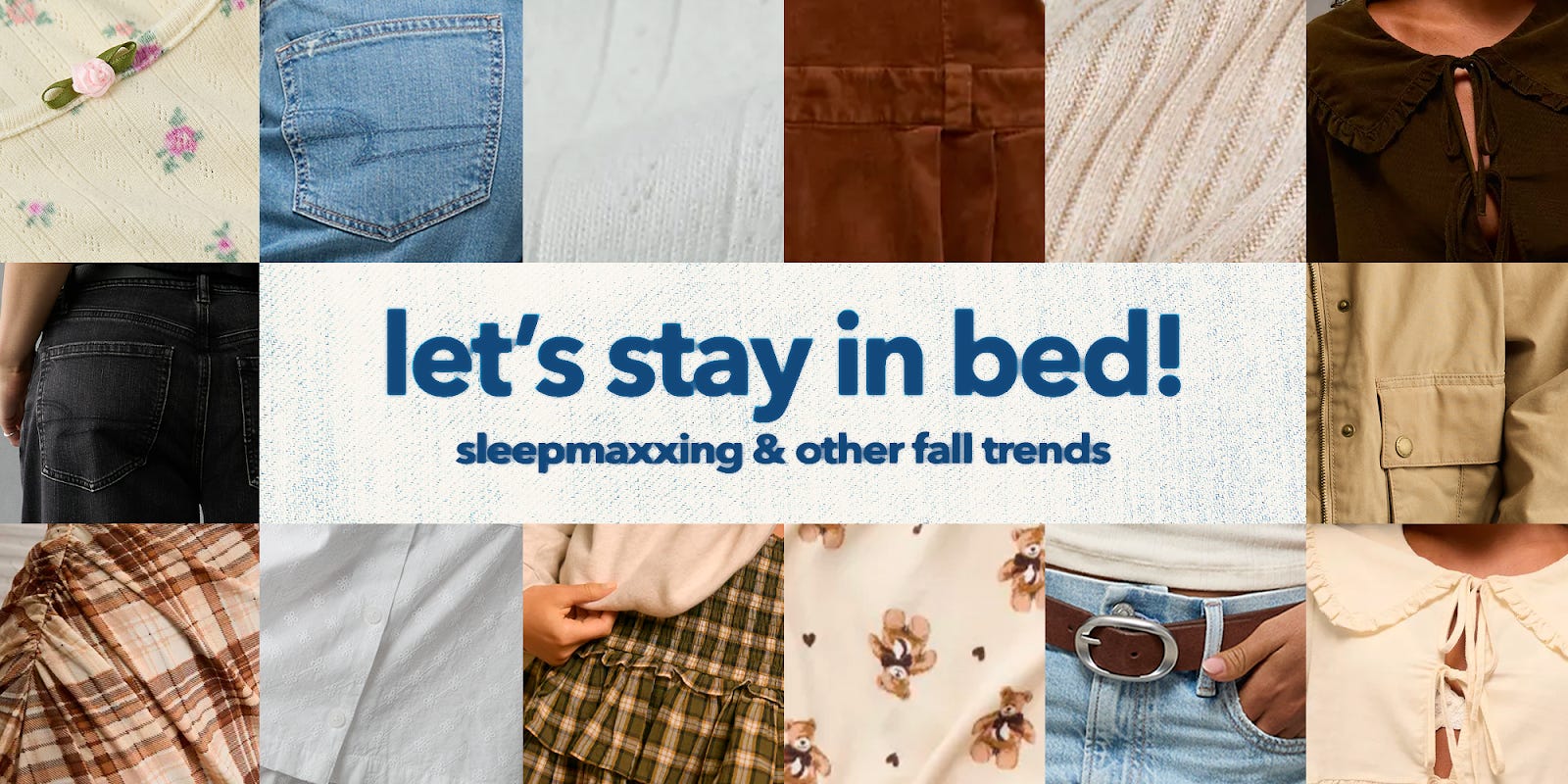
1. Bed culture has taken over Gen Z. You can’t go a day without hearing terms like bed rotting, being in “the bed”, sleepmaxxing, or a general nod to sleep culture IRL or through your algo. With that has come a fascinating sleep economy emerging to target this phase of consumption. On the luxury side, Eight Sleep’s $4K sleep device (doesn’t include the mattress) is beloved by Gen Z’s favorite octopus….. while I’ve personally started hearing people say they’d rather have a $32K Hästens mattress than a Birkin (facts). On the other side, more accessible sleep devices like the Oura Ring or the Hatch alarm clock have become cultural mainstays amongst Gen Z. Additionally, the sleep and bed economy has birthed an obsession with loungewear (this polka dot and this pointelle set are …. delicious), alongside magnesium tonics to ease into bedtime (does anyone remember the tart cherry revolution of 2024??). All of this connects to how Gen Z’s relationship with comfort has shifted: after years of burnout discourse, pandemic isolation, and economic precarity, rest has become both a coping mechanism and a new form of aspiration. Sleep isn’t just functional — it’s now a consumable status category — ultimately, signaling a pathway for identity and stability in an otherwise unstable climate.
2. ICYMI, this week, Google Trends shared that matcha searches are currently up +40% MORE than searches for pumpkin spice. Which is….. woah. I’m also realizing that matcha is to Gen Z as Chai lattes were to Millennials. However, amongst niche circles, I’m aaaalso seeing a steady shift towards conversation around having buckwheat tea before bed (chic). If I were the forerunner of the pumpkin spice industrial complex (lol), I’d probably find a way to make a pumpkin spice cold foam as the seasonal transition from summer’s strawberry matcha to pumpkin spice matcha. And if I were a brand, I’d pay attention to integrating a lot more matcha green. You are what you eat, after all ;).
3. We need to discuss an emergent phenomena that I’m dubbing as SEASONAL DYSMORPHIA. Last week, Pinterest flagged that “winter fashion inspo” is trending +1000% MoM. We’re barely kissing the fall equinox and we’re already subbing PSLs (haha^) for cocoa???? Upon deeper digging (JSTOR for some theory lol), I realized that this actually reflects a broader consumer pattern: when retail calendars and algorithmic cycles churn faster than lived experience, seasonal identity gets dislocated. Sociologists might call this temporal compression — the sense that cultural time is being sped up by commerce and media. For consumers, that means desire is shaped less by climate or tradition and more by predictive algorithms and merchandising schedules. However, this phenomena isn’t as simple to solve (or understand) as it may appear: for a long time, retail has had to operate on a forward-looking calendar. Here, holiday merchandising may start popping up in July, not to rush consumer interest, but because buyers are working 6-12 months out, supply chains are increasingly requiring longer lead times, and relatedly, modern shoppers have begun to expect early access/previews to “what’s next”. From that perspective, seasonal dysmorphia then becomes an economic outcome of accelerated consumption logic, where people and retailers are both primed to live a season (or two!) ahead. Fascinating!!!!!
FALL BY THE NUMBERS
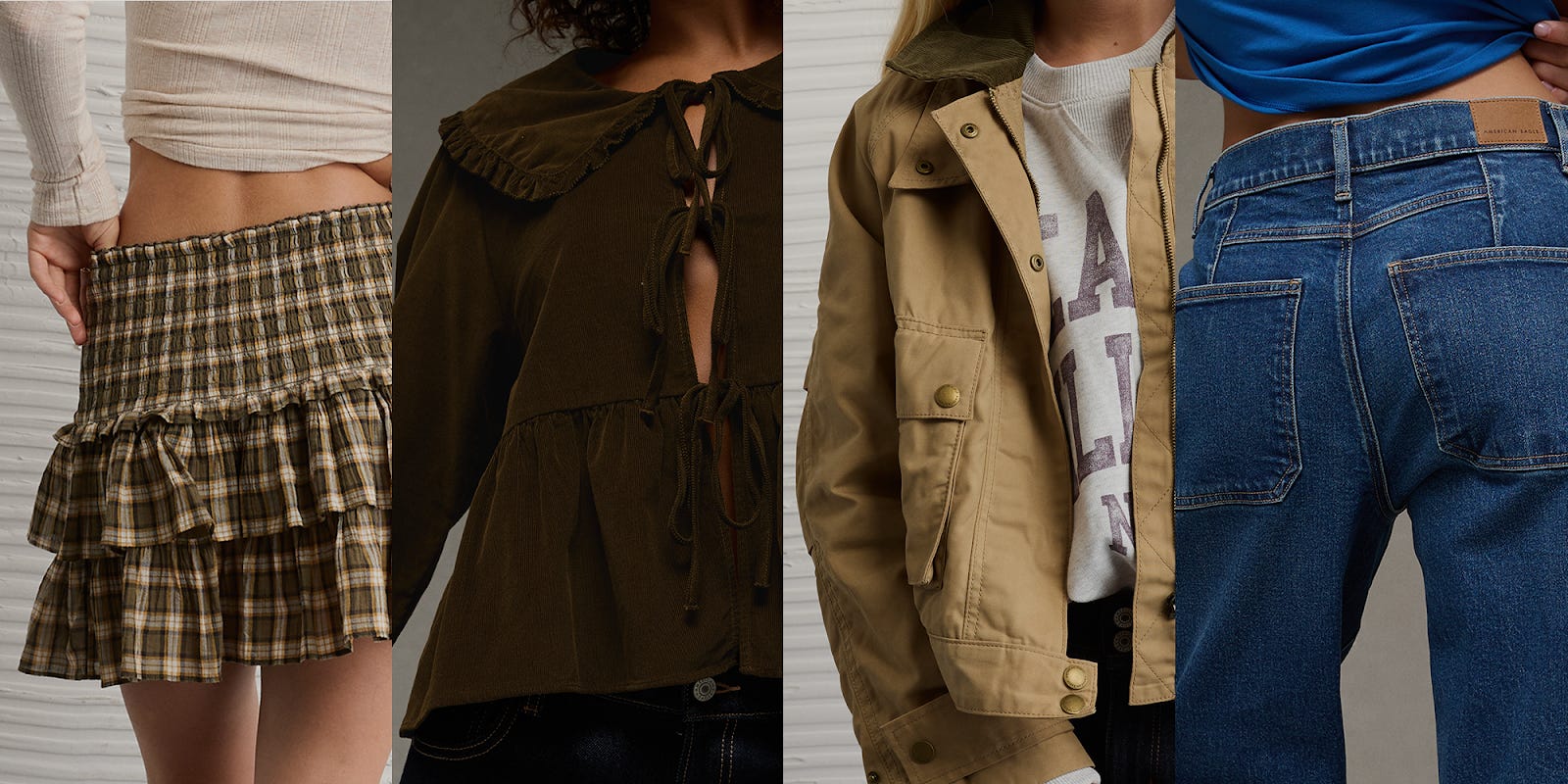
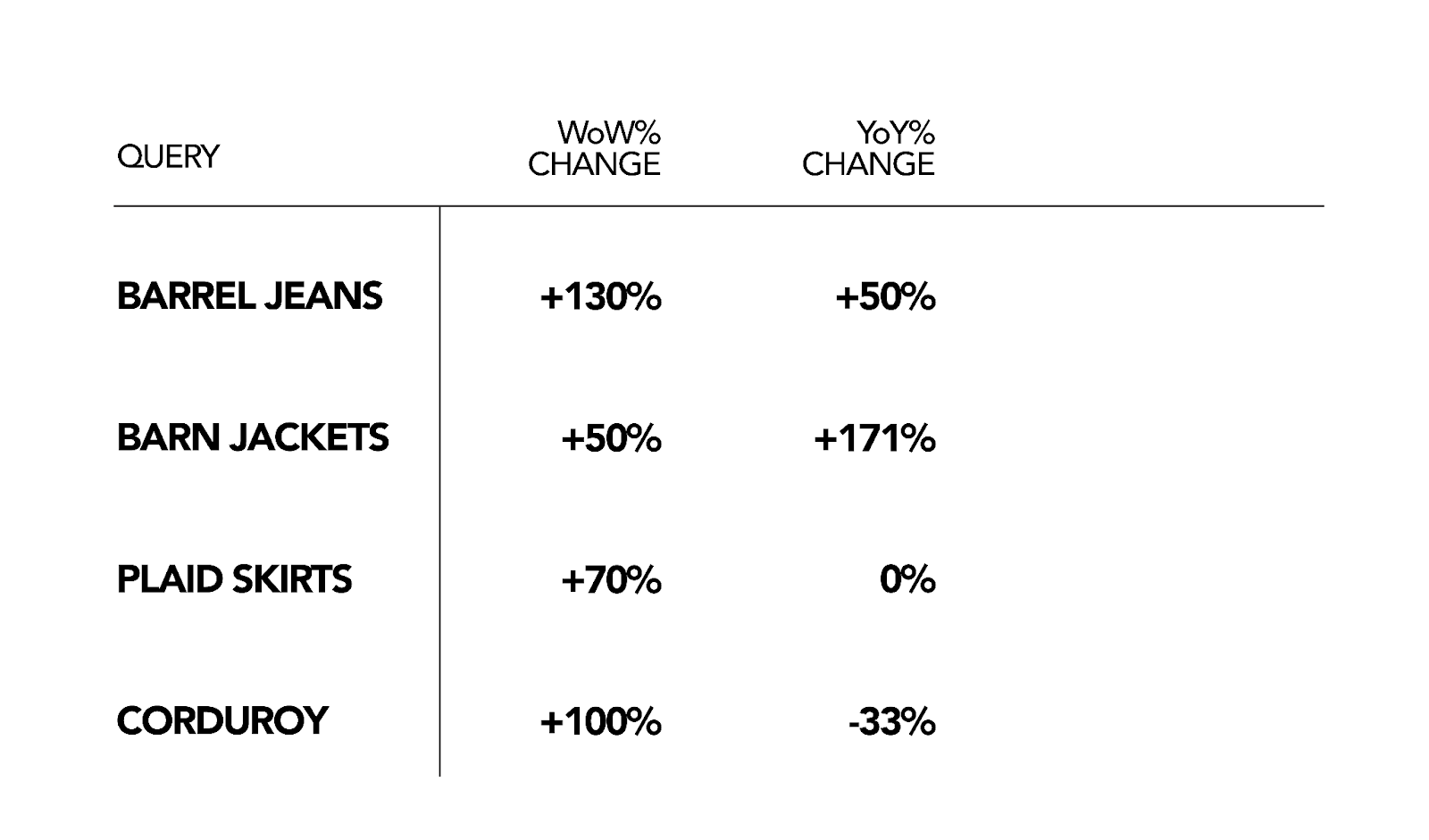
Fall is trending +100% WoW per Google Trends (like duh, is water wet)… however, I’m most interested to see what KIND of fall is trending at-large. If you were to ask me, I’d say argyle knits, rugby polos, khaki, plaid/check prints (these socks!), brushed cashmere, and the color baby blue. But it looks like far more people are asking Google (rude!), and the results fascinate me: barrel jeans and barn jackets are more popular than ever (searches are up +130% WoW and 50% WoW; +50% YoY and 171% YoY, respectively), plaid skirts (+70% WoW, 0% YoY change), and corduroy (+100% WoW, but interest is still trending downwards from 2024 at -33% YoY).
Now if you’re thinking, why is this supposed to be interesting, these trending searches seem obvious…. then you’ve nailed it!!! The “obvious” is exactly what makes it all worth paying attention to.
Why? Well, the fact that they reflect cultural consensus more than the runway is deeply aligned with what we know about algorithms + big data + sociological theory. To paraphrase Bourdieu, taste distinction is a tool that helps us differentiate groups, but (!!) when certain items break through to dominate searches, it suggests that a collapse of distinction is in favor of broad appeal.
All to say that when you’re looking at what trends at scale, you’re looking at the most widely understood and adoptable references, aka — what’s happening at the center. And I’d argue that understanding the foundational building blocks of consumer interest holds the most power. You can always add a cherry and sprinkles to call it a sundae, but what’s the point if you’re missing the ice cream?
WE ASKED, YOU ANSWERED
“What fall items are you most excited to wear?”
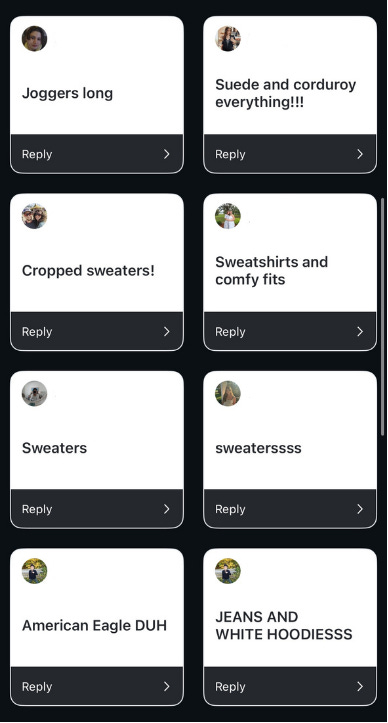
We were curious to evaluate whether or not AE’s audience sentiment mirrored the at-large search data that we analyzed from Google Trends and Pinterest above. To do so, we polled the AE instagram with the question “What fall items are you most excited to wear?”, and the most popular responses included a smattering of: the color maroon (new intel!), suede (new intel!), polka dots (new intel!), hoodies (new intel! – this feels very cousins beach core), cropped sweaters, oversized sweaters, and HIGH waisted jeans (new intel!). When you zoom out, it still paints a picture of FALL, but styled in the AE way. My take? I was most surprised by the at-large interest in high waisted jeans, given younger gen z’s affinity for low rise, alongside the sheer volume of responses highlighting hoodies (comfy-wear is very aligned to bed culture discussed above!!).
Alright, that’s all from me!!! Thanks so much for reading this week’s edition of Off The Cuff, I’m so excited to chat with you SOOOON;
TM x
 | A guest post by
|
sleep is chic !!
I want Tariro on everything...